
English At The Levels School
At Prep the English curriculum is led by a specialist teacher and designed with two major aims;
- To develop skills in reading, reading comprehension and writing (including spelling) that will support learning across the curriculum at KS3 and 4
- To ensure that pupils are able to explore literature and express themselves, both in writing and orally, at age and developmentally appropriate levels. This would be scaffolded to support any barriers to learning which are presented by literacy or language and communication skills
Each pupil has individual targets for literacy development that will be worked on through challenging and engaging class-based literacy and writing tasks. We aim to develop a love of literature and writing so that literacy learning has a meaningful context. One lesson a week will be an IT lesson where the pupils will develop the skills needed to allow them to read and write accurately, fluently, and independently. The pupils will be taught how to use spell checks accurately, how and when to use text to speech or speech to text facilities, touch typing, use of predictive text, and using IT to support proof reading.
The English schemes of learning at both KS3 and KS4 concentrate on building and consolidating the key skills that will prepare students for the best possible outcome at KS4 whatever their level of entry. These skills are embedded in themed examples and content which allow the sharing of vocabulary and ideas with other subjects taught at The Levels School.
As a skills driven curriculum for English, it means that it is a unique curriculum in that it can be personalised and adapted to suit individual needs and promote progress. Each lesson focuses on using the shared literacy based vocabulary and building confidence when talking about work and progress across the half termly schemes and the year group.
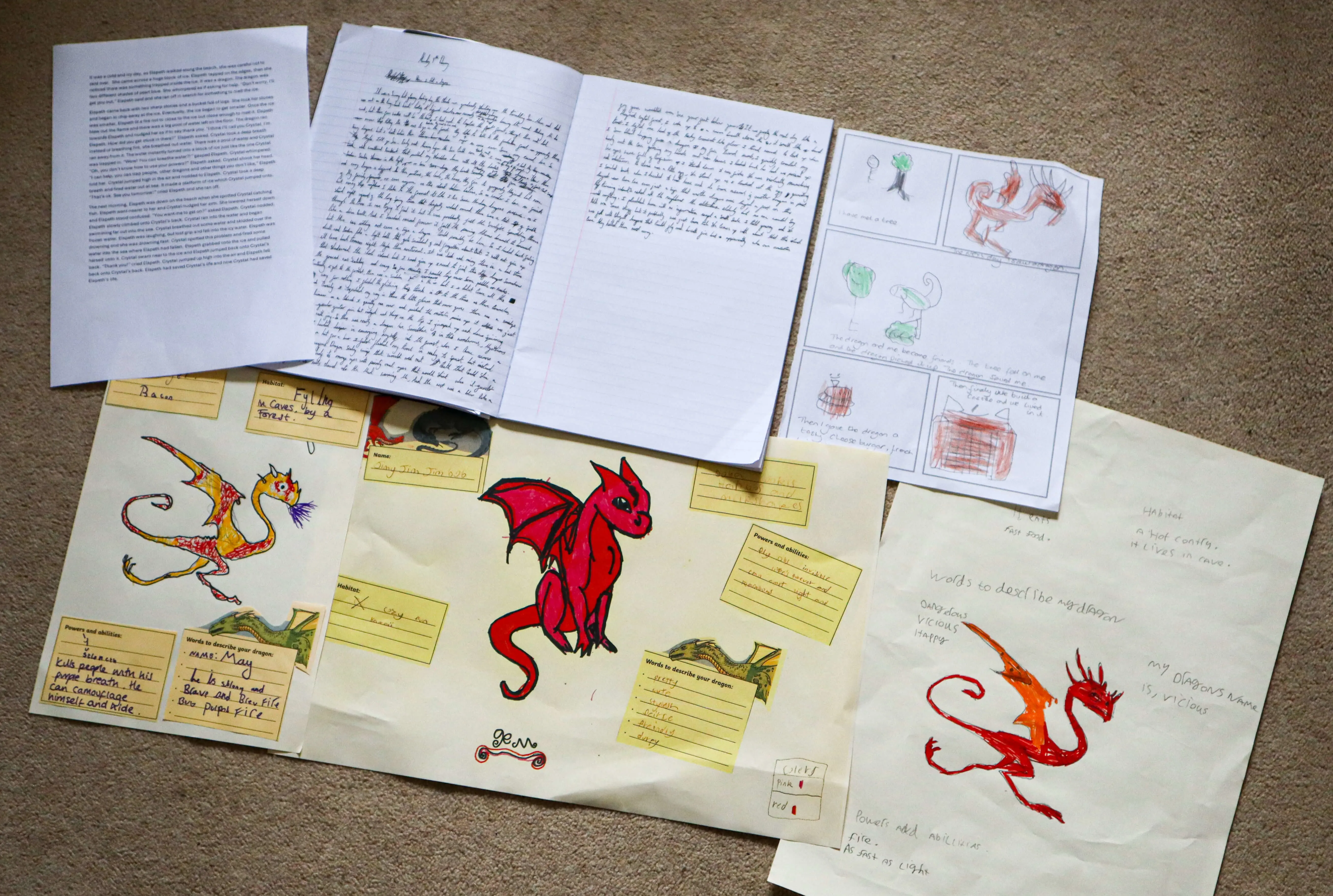
Prep
Reading
When is reading taught?
Our sound work is taught through identifying gaps in knowledge and using a ‘Word of the day ‘approach to teach these. We understand that many of our students have a real aversion to reading and therefore we prioritise building up confidence and supported in their reading through a flexible and adapted approach.
An adult reads the class book aloud every day during book club and we use the VIPERS approach of Vocabulary, Inference, Prediction, Explanation, Retrieval, this helps our students learn skills of comprehension and understanding text. This also applies when our pupils read their own banded books to adults.
Resources for reading
Teachers use objectives from the National Curriculum to aid planning for their students. We have a vast array of phonics based banded books for individual reading and phonics based guided reading books. Our Reading Curriculum is rooted in a wide range of high-quality visual literacy, picture books, extracts from novels, poetry, song lyrics and non-fiction texts. Class books are selected by the class teacher and always provide a level of challenge.
We encourage students to use non-fiction books for research during our termly themes and always supply a selection of books related to this.
How do we assess in reading?
Assessment takes place by teachers and teaching assistants through all their learning which involves any form of reading. Any issues are identified, and discussions take place how best to help the pupil move forward in their reading and strategies given.
Spelling
When is spelling taught?
This is taught during the daily sound work. Regular formative assessments take place during these times and during all other learning involving any form of writing task.
For many of our students spelling is incredibly difficult and support strategies are put in place for them to be able to access the curriculum.
We encourage our students to self-correct and give them opportunities to do this taking ownership of their work.
We believe that feedback at the point of learning has the biggest impact on a pupil’s progress.
Writing
When is writing taught?
Students access writing across our setting in a variety of ways. Many have been traumatised by previous writing approaches, and it is our job to build up their confidence in this area.
We do this through different approaches and giving the students time, encouragement and positive feedback. Improvement areas are dealt with in a sensitive manner, directly with the student and with trusted adults.
Some of our students require a scribe for longer pieces of work, for others it is giving them a longer period to complete a task.
We foster enjoyment of writing through modelling, shared, peer and individual tasks.
How do we assess in writing?
This is continually being assessed and feedback given.
Prep students are taught in mixed-age and mixed-ability groups consisting of children from Years 3 to 6. All Prep children are taught the same curriculum which is adapted for individual needs. To avoid repeating the same units, the Prep curriculum has been mapped over two years, with students studying different units in years A and B.
| Year A | Year B | |
|---|---|---|
| Autumn 1 | Historical Stories, Recounts and Slam Poetry | Classic Fiction, Recounts, Choral/Performance Poems |
| Autumn 2 | Biographies and Autobiographies, Instructions and Explanations, Classic Poems | Significant Authors, Instructions and Explanations, Narrative Poems |
| Spring 1 | Short Stories, Argument and Debate, Poetry Style | Stories with Flashbacks, Persuasive Writing, Free Form Poetry |
| Spring 2 | Shakespeare, Reports and Journalistic Writing, Poems on a Theme | Tales From Other Cultures, Non-Chronological Reports and Journalistic Writing, Classic Poems |
| Summer 1 | Classic Fiction, Persuasive Writing, Poetry | Classic Fiction, Chronological Reports, Poet Study |
| Summer 2 | Fantasy Fiction, Non-Chronological Reports, Power of Imagery | Modern Classic Fiction, Information Texts, Dialogue Poems |
Key Stage Three
In Key Stage 3 we work on key literacy skills such as reading and spelling alongside access arrangements so that students who struggle in these areas have not only the tools to make improvement but can access the higher level GCSEs even if their literacy skills remain a barrier.
| Year 7 | Year 8 | Year 9 | |
|---|---|---|---|
| Autumn Term | Reading Focus – with a look at a Class Reader; Freedom 1783 and extracts from a range of Gothic Fiction from Frankenstein to Whispers in the Graveyard | 19th Century Voices – we look at a range of fiction and non-literary fiction, from travel writing to social commentary and A Christmas Carol | In Year 9 we zoom in on language in a GSCE thematic style poetry study and then how language is used to influence readers in a project on the language of advertising |
| Spring Term | Introduction to Poetry through structure and language tools like Metaphor, personification rhyme and alliteration. We also take a look at the presentation of key characters in Macbeth |
Next step poetry – looking at how different poets have presented the idea of Heroes and bravery in longer narrative poems. Grimm Tales and the idea of a Disney Hero compared to original folk lore |
Reading is our Spring focus with a literature style approach studying either The Crucible or Gone Then it’s a look at Othello or Romeo and Juliet and stereotypes with a stage building project to finish |
| Summer Term | Is all about the Drama – we look at playscripts and write both fiction and non-fiction pieces around the theme of Animals | Reading our spooky class reader – we look at Neil Gaiman and The Graveyard Book or Artic Star and then move onto how stories are told through drama in A Curious Incident or Our Day Out | A study in Crime – we look at texts that contributed to the evolution of crime fiction writing from Sherlock Holme through to Dahl and Christie, culminating in a murder mystery dinner party and Who Dunnit |
GCSE
We offer students a coursework option currently through Cambridge IGCSE. We are looking to reintroduce GCSE Literature in the near future based on what our current Key Stage 3 students are interested in.
We complete 3 pieces of assessed written coursework (500-800 words each) worth 50% of the overall grade
- Narrative – a short, complete story
- Descriptive piece – a description of a setting or a given image
- Response to an article – students choose an article with a clear opinion on a topic of their chose and respond in letter form.
There is a final exam (50%) involves reading 3 non-fiction extracts and then answering short and long format questions assessing retrieval, inference and vocabulary. The written questions assess summary skills, and then transformational writing where students are asked to write a letter, speech or article from the point of view of someone they have just read about.
External Links
| Brain Pop | Primary Literacy |
| Young Writers | Spark Notes |
| KS2 Bitesize | KS3 Bitesize |
| Seneca Learning | Khan Academy |
| Oak Academy | Newsround |
| The Day | World Book Online |
| Somerset Libraries | Free eBooks |
Holiday Activities
If you're looking to support your child's English studies at home, try the following activities:
Engage with books for pleasure, whether it's audiobooks, ebooks, paper books, graphic novels, comic books, short stories, poems, magazines, news articles or any other kind of books! We recommend at least 20 minutes of reading for pleasure a day.
Discuss the news and current affairs, perhaps after watching Newsround or reading an article on The Day (linked above). For older children, you could discuss the use of emotional or biased language in a news story.
Watch films and TV shows, especially ones based around books that children are reading. Children can enjoy discussing the similarities and differences between book and film versions. Children who might struggle with the language in classic books may find the film versions easier to access. Play word games, such as 20 Questions, Who Am I?, Boggle and Scrabble. These help children to learn and embed new vocabulary.